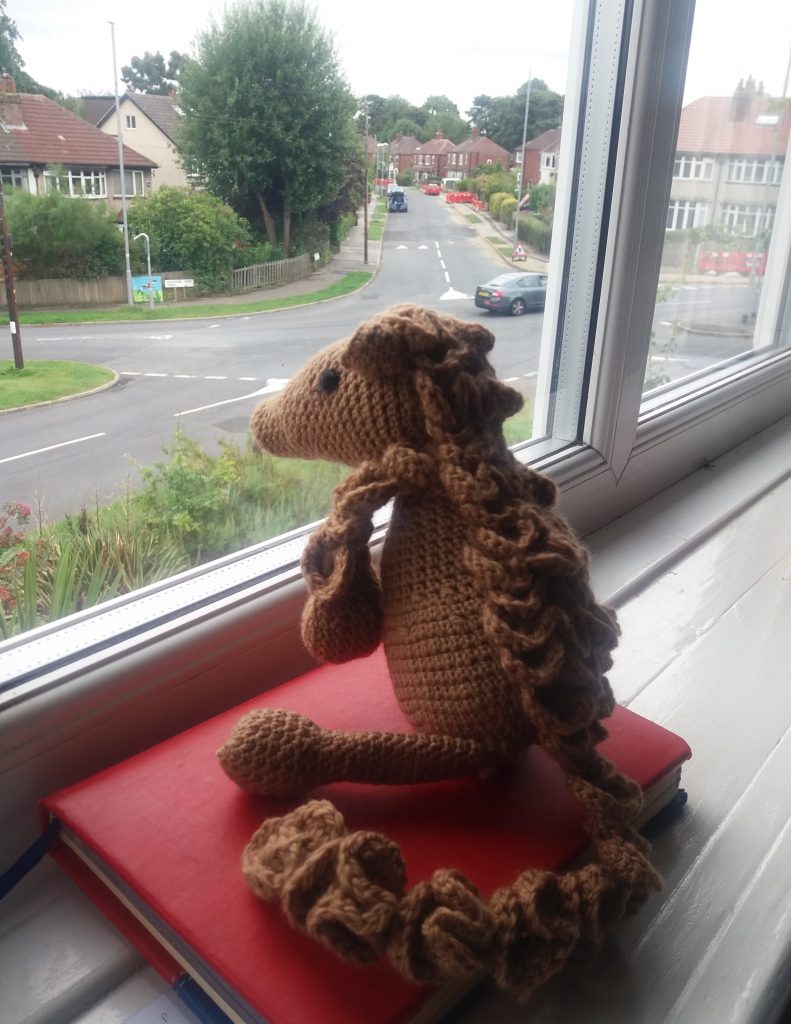
Here’s Petronella (Pet for short, said in a Geordie accent) watching our street last week. My new alter ego, carefully crocheted by one of my daughters, arrived in perfect time to keep me company during Covid-induced isolation. This pangolin has something of the Clangers about her, as she watches over our five-way junction and all the comings and goings. My brush with Covid was relatively mild, thanks to being doubly vaccinated. I’ll leave it to you to judge how much it has affected my brain – naming a woollen pangolin Petronella may be near the edge of reason. My brief encounter with the sick role gave me an excuse to read Unseen Academicals by Terry Pratchett which was a hilarious take on all things football and just the distraction I needed.
Luckily we are away this week, in a cottage overlooking Bassenthwaite, a perfect place to recuperate and reflect before all the activities of autumn start hammering on the door. In the view above, Pet’s head obscures the little library built by an asylum-seeking friend of ours. This wooden cupboard on a pole has proved to be very popular in the neighbourhood. It’s only been vandalised once – a young man punched through the perspex door late one evening. This was after someone else, a child perhaps, had sprayed a heart on it with the word Mum in the centre. These two observations may be unconnected, but the coincidence feels like the beginning of a story. I could have set off in pursuit of the young man to ask the question why, but hints of fists and alcohol restrained me.
Before we left for The Lakes, I donated my copy of The Mermaid of Black Conch, which I thought was brilliant, and borrowed Vernon God Little, exchanging a Costa for a Booker. I finished Vernon God Little within a day – it’s that sort of book – funny, tragic and so full of the stench of corruption that it’s best held at arm’s length between finger and thumb, like soiled underwear. In his non-fiction book for novelists Release the Bats, DBC Pierre encourages us to switch off the internal editor and let our subconscious rip, as he has done with Vernon. I’m not sure what to think about the fact that I share the set of initials in Pierre’s pen-name which, according to his Wikipedia entry, stand for Dirty But Clean.
Looking out over the pale yellow plain between Bassenthwaite and Keswick, with clumps of dark trees emerging from mist in the morning, I could be observing an African savannah at dawn. Here be no lions, but there were ospreys, who will have migrated south by now. Gazing up at Skiddaw, half-hidden by morning cloud, I could, with a little imagination, be looking West from Kagando in Western Uganda into the piled-up hills of the Democratic Republic of Congo. My habitual restraint, which confines any pungent raucous fruit-bats in their upside-down roost in my head, led me to use the subjunctive in those descriptions.
We visited the Thornthwaite Gallery last Saturday, after a slow and sometimes breathtaking scramble, skirting round The Bishop to Barf (six words that sound like they’ve dropped straight out of DBC Pierre’s fertile mind) and a stroll back down forest tracks to the village. Whilst appreciating the control of some of the artists, we preferred the the more impressionistic watercolours and acrylics. That’s what we both aspire to in our creativity – less restraint, more imagination. I’m at the point in the first draft of On Thin Ground when the reader has reached one false summit, only to find that there’s more story still to come. Problem is, the author doesn’t yet know the shape of that final peak. Somehow I have to get all the major characters somewhere that none of them want to be, first hints from the subconscious are that it’ll be the three-year-old that leads them there.
In real life, I am now officially registered as a postgraduate research student with the University of Leeds. With expert supervision from the School of History, I will excavate the archives concerning The Preventorium at The Hollies, putting it in the context of other Sanatorium Schools. In preparation, I have been reading the annual reports of the Medical Officers of Health for Leeds from about a hundred years ago. The dispassionate description by Dr J Johnstone Jervis of the harrowing wrought by pandemic flu is all the more distressing for its objectivity.
So, here we have a pangolin that proclaims that I want my writing to be more creative and less constrained but I am actually about to immerse myself in history for a couple of years. I’ll let you be the judge of whether that could be regarded as logical. Outside, the swallows are getting ready to follow the ospreys south. If you ever wondered whether non-fiction could be as exciting as fiction, whether real life can be as perverse as the most fevered imagination, I would recommend A Single Swallow by Horatio Clare which traces the swallows’ migratory route from Southern Africa to Wales.
The second in our series of real-life pangolins is the Sunda pangolin, thought to be the most-trafficked mammal in Asia, not a cachet that any species would choose to have. If you look closely, one of the bits of street furniture in Pet’s field of vision is a comms box with a red kite painted by local artist Megan Dobbyn. Her art is part of an initiative by Chapel Allerton Spaces with support from the Friends of Gledhow Valley Woods. I’m old enough to remember when, thanks to merciless egg-collectors and misguided gamekeepers, red kites were only to be found in the fastnesses of mid-Wales. Now it’s unusual not to see one overhead in Leeds – a spectacular return due to a re-introduction of the species at nearby Harewood. Gledhow means ‘hill of the kite’ so the birds really are back where they belong. Perhaps there’s hope for pangolins yet.
The next new moon is on October 6th when my seventy-third pangolin will be released into the wild, please look out for it.