
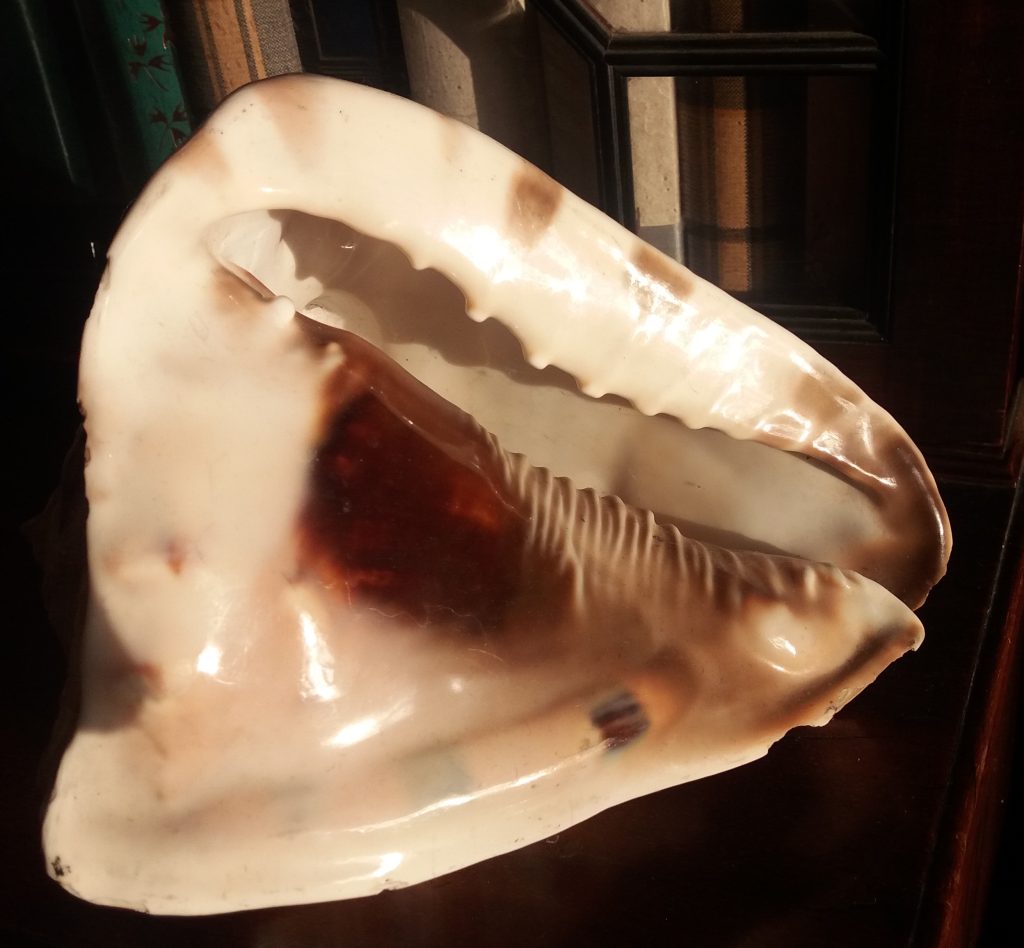
This beautiful conch was a gift from Bert Batham, now long gone, who I adopted as my honorary grandfather when I was eight. The perfect shell is, I hope, a fitting image for this my last pangolin. Don’t panic – I remain in good health – but the creative writing is on a temporary pause and I don’t want to change the theme of these bloglets. I had a look for Bert on the internet, there’s one mention of his name from his time with the Methodist Church in the Bahamas but also an extraordinary silent film, donated by his daughter Joy, which is now part of the Yorkshire Film Archive. It shows him as a young man with the Sheffield Spartan Swimmers. Apparently he is one of the three fooling around at the beginning but I can’t say that I recognise him. My history supervisors are encouraging me to immerse myself in the 1920s and ’30s, so what better place to break the ice than with an open air swim on New Year’s Day 1933?
Last month we were thinking about listening, and the ocean sounds within a conch would have been a good way in to a further auditory discussion, but instead we will drift on the current into the visual, inspired by the aptly-named Bert Batham. Some of my friends in the Leeds Writers Circle write in a more filmic way than others. I didn’t know that filmic was a legitimate adjective until I joined the group, but it does the job well. We write in scenes, and modern novels often have a plot structure that borrows heavily from the movies.
Pam and I subscribe to Cinema Paradiso which ensures that my narrow and over-busy mind is exposed to a different movie every few weeks. There have been some turkeys, but we usually find something to enjoy. The latest offering was The Truth, a thought-provoking film of the making of a film, but really about mother-daughter relationships and the unreliability of the truths we think we knew about each other, and ourselves. The story would make a good novel.
If The Truth is a bit of a niche movie, Don’t Look Up should be a blockbuster. Like many thousands of others, we watched it on Netflix over the Christmas holidays. It really has to be a film, a novel wouldn’t do it justice, with its CGI graphics of a comet hurtling towards the earth. I’ve been saying for some years that if there was an asteroid on a collision course with earth then the global powers would get together and blast it out of the sky, but because climate change is insidious, we don’t act. Don’t Look Up challenges my breezy assertion about how we might respond to an asteroid and piercingly satirises tawdry politics, big money and our obsession with influencers on both social and other media.
For me, there were echoes of Dr Strangelove, Stanley Kubrick’s cold war epic from 1964. Peter Kalmus, a climate scientist, writes that Don’t Look Up captures the despair he feels every day. I hope this film helps to energise people, including me, to respond to the real and present threat of climate disaster. As Kalmus says, what we need is more good stories of people acting together to make a difference, we already have more than enough data. In one of the penultimate scenes of the movie, astronomer Dr Mindy, played by Leonardo DiCaprio presides over a last supper in his family home and says ‘we really had it all, didn’t we?’
This, my only pangolin of 2022, emerges just over six years after the very first one sniffed the air. The whole rag-tag series is available free on this website, if you would like to delve further. I’m not sure how my current preoccupation with the social history of childhood tuberculosis is contributing to the global search for solutions to our climate catastrophe, but perhaps it’s helping to keep me sane.
In William Golding’s Lord of the Flies, holding the conch enabled a boy to be heard, it was a way of ensuring that everybody could have a voice. The conch has many more ancient symbolic meanings in Hinduism and Buddhism. If they put their ear to it, my conch shell will whisper clean blue oceans to the grandchildren. Let’s make sure that our descendants’ voices are listened to as we learn to be better ancestors, and fast.
Just for a change, this pangolin is being released a day early, on the cusp of the new moon. Perhaps, as this is the last issue, you would like to make a donation to the real pangolins, so they can still be around for the healing of our planet, which we’re all going to work together to achieve, aren’t we?