
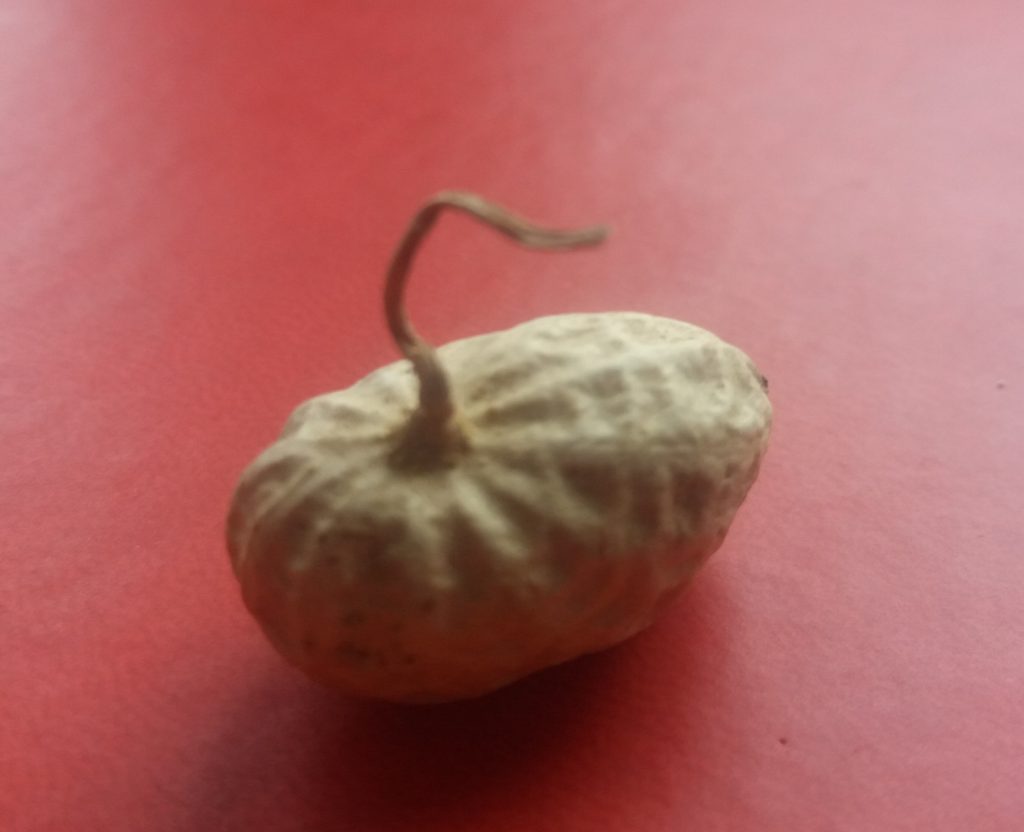
Pam was weeding the allotment a week or so ago when she unearthed this. She tells me it’s not the first season she has found one. I had wondered about the alfalfa-like plant with the bright green leaves. Folks, we have groundnuts (a.k.a. peanuts) surviving and self-seeding in Leeds. Yes, groundnuts, whose natural habitat is way south of here. Last weekend, at the beginning of October, I was assisting with a junior youth residential near Thruscross and was shocked to see martins still swooping low over the reservoir. On the walk back, some were assembling on wires, giving the impression that they would eventually get round to migrating south. If any more evidence of climate change were needed, which it isn’t, we only need to open our eyes.
This week marks the official start of my two-year MA by Research with the Department of History at the University of Leeds. They were kind enough to take me on, even though I have zilch qualifications in history, and that includes at GCE level. Regular readers of this bloglet will know that I am very interested in the history of the Preventorium that was at The Hollies on the edge of Meanwood Park, Leeds, 1925 – 1956. I recognise that not everyone will find this as fascinating as I do, so I will try not to bore you with the minutiae. One thing that becomes very obvious, very quickly, to the new student of history, is that historical evidence is a more slippery thing than, say, the evidence for Hooke’s Law.
One of the sources that I am reading early in my exploration of my subject is The Children of Craig-y-Nos: Life in a Welsh Tuberculosis Sanatorium 1922-1959 by Ann Shaw and Carol Reeves. Craig-y-Nos was an altogether grander and more remote setting for the care of children with tuberculosis, than the relatively small and suburban setting of The Hollies. Craig-y-Nos Castle had been the home of the internationally-famous opera singer, Adelina Patti. From the outset, Shaw and Reeves’s work was one of public engagement with those who lived at Craig-y-Nos, both as patients and as staff. In a reflective piece a few years later Carol Reeves looks back on the project and points out some of the challenges. Sometimes she found herself, as a historical researcher, acting as an untrained counsellor for those who needed to talk, often for the very first time, about long-buried experiences from their childhoods. Public engagement meant that patients and staff had the opportunity to meet together. Memories that had appeared immutable to their owners, become less fixed after conversations with others. It’s a remarkable project, which started as a blog and made its way on to TV. We certainly have to think about the ethical implications of public engagement of any sort.
Fiction writers have a choice about who tells their stories, is it an omniscient narrator, a first person protagonist, or are there multiple narrators, each with their own axe to grind? Students of history are aware that what survives in the historical record is often written by the powerful and privileged, almost always by the literate. For students like me, who really want to hear the voices of children who lived at The Hollies between the two world wars, it’s going to be a challenge to find any of them.
It was Atlantic weather for the weekend of the junior youth residential with a succession of depressions sweeping across our little country. Perhaps the martins were waiting for a change in wind direction? We altered the order of our programme for the Saturday so we could get the children out on a walk before the worst of the weather hit. I say ‘walk’, but for this age-group it’s important to have some activities along the way, so we had cairn-building, snacks by the old mill and our last activity was constructing dens out of fallen tree branches. When shifting stones to make cairns, we were joined by a lone farmyard duck. I should have taken a photograph for you but if you remember Beatrix Potter’s Jemima Puddleduck you can visualise our visitor. She/he/it was very friendly, inspected the cairns and later swam round the reservoir’s edge to join us for snacks. Unscripted events, like the arrival of a lone white duck, add an extra dimension to an expedition, and something to chat about on the way. As a new student of history, I am starting to explore the literature at the intersection of twentieth century / tuberculosis / institutions / education / public health / childhood and hoping that some unexpected inspiration will waddle into my field of view.
Hooke’s Law is for springs and wires and such, but I often use it as an analogy for the stress of work and life. It’s good to be stretched, but it’s unwise to allow the forces applied to go beyond our elastic limits. As we get older, our tensile strength may not be all that it once was, so we need to pace ourselves. You are most welcome to that pearl of wisdom.
As will be obvious from reading this breathless bloglet, it has been written against a deadline. As per usual, I’m not heeding my own advice. History tells me that I’m unlikely to do any better in November, but at least I have insight. The real pangolin for this lunar month is the black-bellied species which lives in West and Central Africa.
Have a good month!