
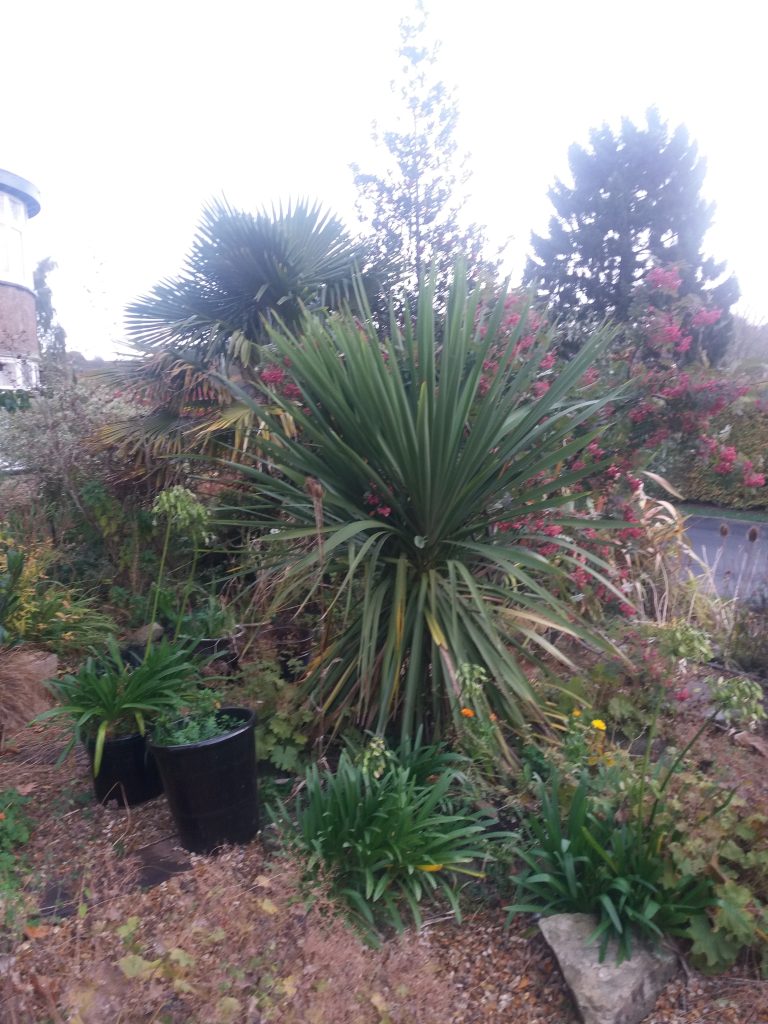
This photo could be called Revenge of the Cordyline which sounds like a science fiction B-movie. Way back in the annals of these pangolins, I’m sure you could find an account of how a friend and I attempted to get rid of the root of the cordyline after it had apparently died in the harsh winter of 2011; and its ultimate resurrection about three years later. It is now at the stage of slowly strangling the ornamental pink-berried Sorbus that was planted to replace it. Yet another sign of climate change as a Northern temperate species is ousted by a Mediterranean one. Hopefully the Sorbus will continue to provide food for winter thrushes for a few more years before it finally cops it.
Speaking of which, COP26 is on in Glasgow and Pam was delighted to see that the family-produced banner had made it with other contributions from North Leeds Craftivists via Stitches for Survival onto Glasgow Green yesterday. Pam and I were on the climate march in Leeds yesterday, a positive gathering, led by a trades union brass band through the streets of the city. We were under a Churches Together banner which read No Copping Out. It was an occasion to meet old friends, make new ones, but also to be disappointed by the relatively few thousand people who turned up and the apparent disinterest of many shoppers as we passed by. If the climate emergency was an asteroid hurtling towards us, the world would have sorted it by now, but this is a slow burn. The breeze was quite strong, so it was difficult for those of us holding the poles to keep hold of it – there’s a parable in there somewhere.
As well as groundnuts self-seeding on the allotment (see Pangolin 73) we have quite a few tree seedlings popping up there, and in the garden. The City Council don’t want home-grown saplings (on the grounds of ‘biosecurity’) so we’ve got into the habit of guerrilla tree-planting. As Banksy has said, the best way to perpetrate something in a public place, for which permission might not be granted, is to don a hi-viz jacket and, if anyone asks you what you are doing, complain loudly about the rates for the job. We’ve taken to planting trees on rural roadsides, with sufficiently wide verges to escape the worst of the salt from winter gritting and where it looks like sheep don’t graze. Some hardy trees are already established there. We hope that, in another decade or so, ‘ours’ will have put down enough roots to join them and eventually form a hedge of sorts.
All this ‘eco-warrior’ stuff hasn’t had much to say about writing, the primary purpose of this bloglet. Sorry about that. I think it’s likely that I might round off this series once I have made sure that each of the eight known species of pangolins has had a proper mention. That would take us to about Pangolin 77 – as good as any number to end on. We do have a meeting of the novelists’ group of Leeds Writers Circle this Tuesday. I have just finished four critiques of my fellow scribblers’ work, so it’s kept the basics of writing technique in mind, even if I haven’t done much myself. I’ve been immersed in 1920s Egypt, contemporary Afghanistan, 1950s Britain and somewhere in our galaxy in the not-too-distant future – it’s amazing where words can take you.
The question I ask of my colleagues this month is whether the ‘reveal’ of a cunning plan by two of my protagonists is too obvious, or too obscure – I’m hoping that they will agree that I have ushered my readers into a Goldilocks zone. This isn’t the case for the script for a grandchild’s book that is already overdue (the book, not the grandchild). Each member of that generation is supposed to get a book on their second birthday – she was two in August. Usually I spend a couple of hours writing some mildly entertaining words and Pam takes about four months to paint the beautiful pictures – which seems like a fair division of labour to me. However, this time I’ve been told that not much happens in the story, so I’ll be taking some blank sheets of paper with us next week, hoping that inspiration dawns over the Solway.
This month’s pangolin is particularly late, possibly because it’s of the Chinese variety who like to dig a deep burrow for the winter so it took a bit of unearthing. Their winter homes are usually adjacent to termite mounds so they have a reliable food supply on tap, sensible things. Let’s hope that enough of them can evade the poachers. During a generally disappointing week for the climate, the discovery of indigenous bees in the ancient oakwoods near Blenheim Palace has really cheered me up. Their queens cooperate with each other, the honey is delectable, their nests are not too big and not too small. Goldilocks would approve.