
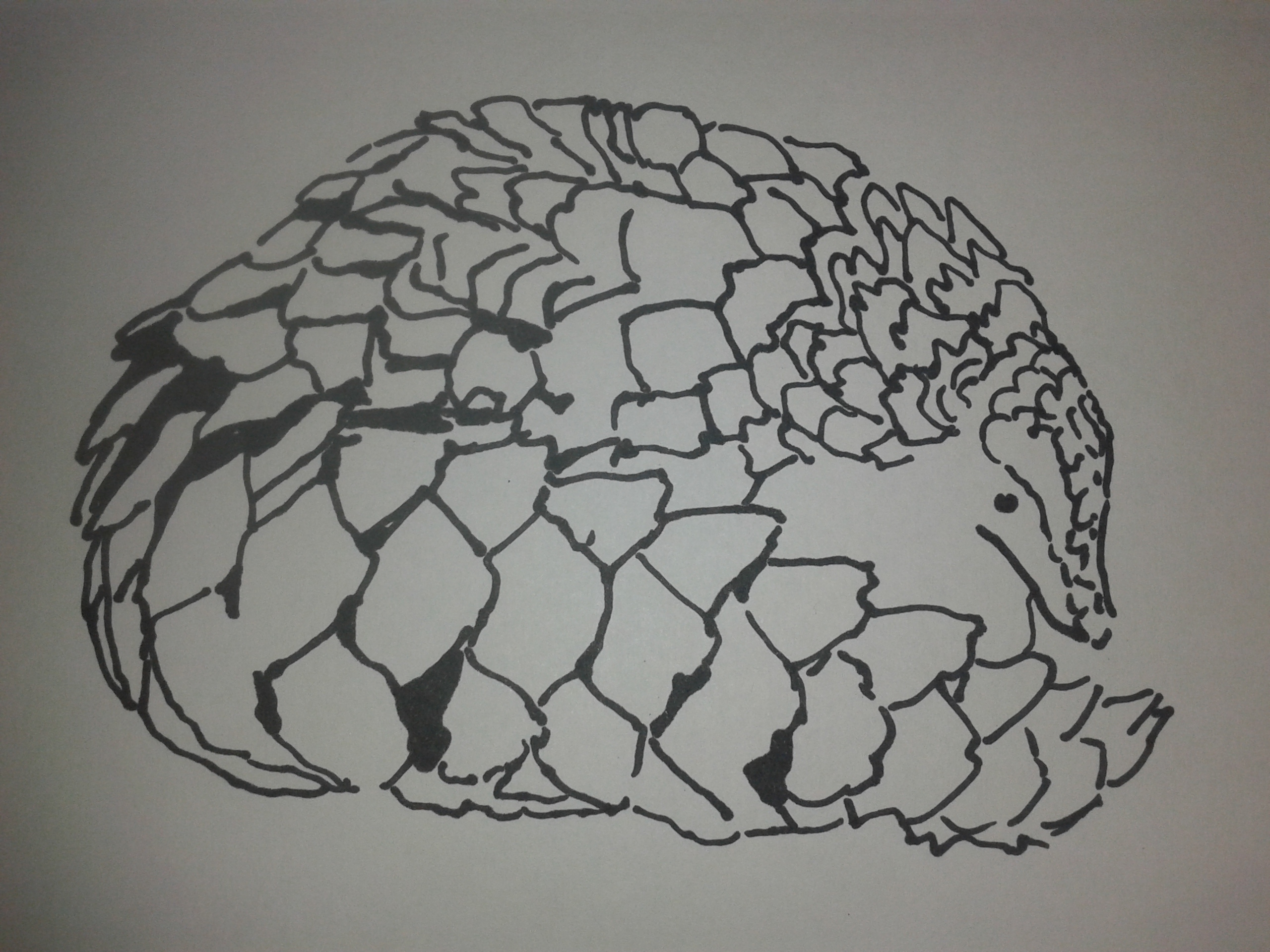
This pangolin is devoted to voice, more specifically to authenticity. Imagine it as a more than usually reclusive pangolin, not certain whether it should emerge from its hiding place at all.
I’ve been thinking about voice again because Avril Joy, who very helpfully critiqued one of my stories recently, was not convinced by the voice of the main character – that’s more than a bit of a problem. When you realise that the voice is that of a Nigerian teenager who has grown up in the UK and Avril knows I’m an almost pensionable white Brit you can see this could be a BIG PROBLEM.
I could assert, sniffily, that I know a few African teenagers in the UK, who came here as young children and whose voices are, to my ears, indistinguishable from their British-born friends. My pangolin might still retreat into its burrow, burdened with the disturbing thought: ‘but do you really know?’
Twitter has just pointed me in the direction of a balanced article on the privilege to write about those from other cultures by Salil Tripathi which is well worth a read. Her article was written in the aftermath of some strong words from Lionel Shriver at a conference in Australia, and some even stronger words about cultural appropriation by others in response. My first novel, Walls of Fire is, to some extent, a celebration in fiction of the real midwives from Africa and the Caribbean who ran our local NHS maternity units at night. The heart of the novel is Yetunde, who may be an archetype but she’s definitely not a stereotype. Readers are responding to her in the way I hoped they would. I have it on good authority that her Yoruba voice sounds authentic.
The written page deprives us of the timbre of a voice. A quirky use of words, or word order, helps to anchor a character’s voice – Yetunde often speaks in rhetorical questions. Another African friend usually does insert ‘do’ or ‘did’ between the subject and the verb – not for emphasis – he just does. Niamh O’Farrell (in Green Goddess) says, of Teresa of Avila, that ‘she was after reading the wrong sort of books.’ From this and her name, we know where Naimh’s from. But you don’t get much of an idea of her voice, or my friend’s, just from these turns of phrase.
Voices in books only become believable if they are embodied in and emerge from a three-dimensional character. Yetunde’s voice works because the reader builds up a mental image of the way she moves, sings, jokes, fears, sweats, cares. I’ll listen hard to my teenaged African friends in the next week or two, but I think that if I’m going to nail the voice of my main protagonist, I shouldn’t worry too much about his exact words. I should work harder to flesh out his character – through his actions, of course. Let’s see if the next lot of short story judges agree…
Better news for the real pangolins this week. They’ve all been moved to Appendix 1 of CITES -which means that any trade in pangolins or pangolin parts any where in the world is now illegal. My next pangolin is due out on Oct 30.
Nice article David. Voice is difficult: the struggle to differentiate individual characters and yet identify them as being from the same tribe be that a family, community, age group, job, era and so on. Lovely illustration.
Hi Jenny, very sorry to be sooo slow to reply to your encouraging post about my last one. Pangolin 12 will attempt to burrow into something deeper and should emerge on Oct 30. Best wishes for your writing. David