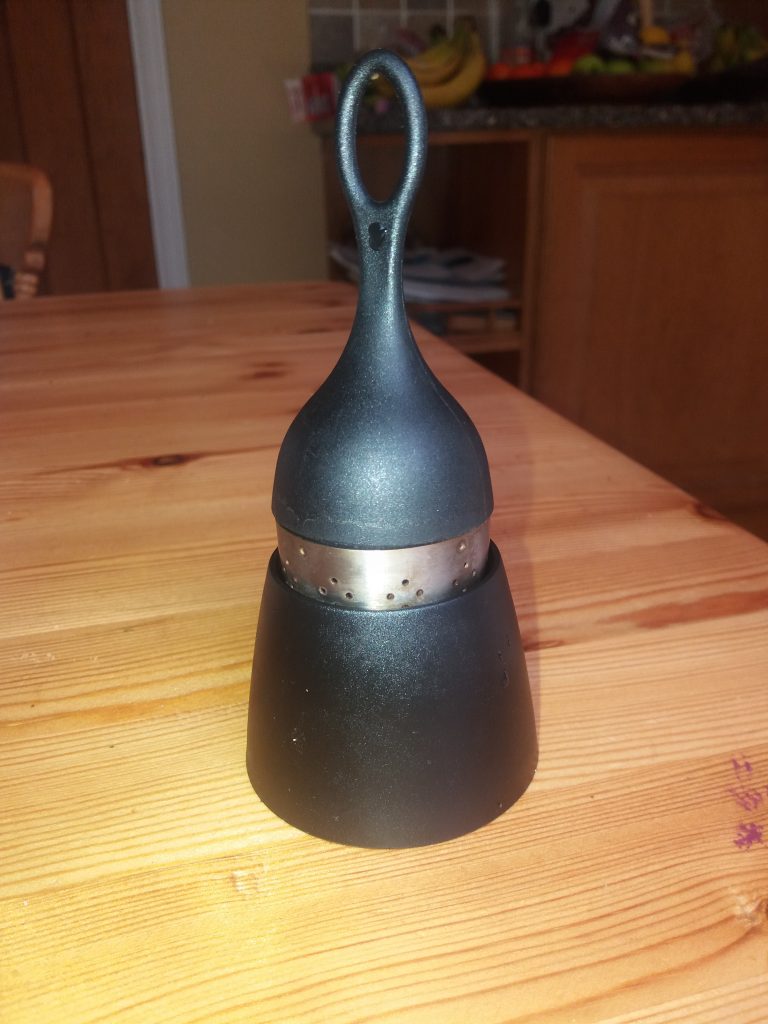
Well, here’s a thing. When it first arrived, hidden in a dark corner of my wife’s online order from Lakeland (the company, not the National Park) it reminded me of something from Moominvalley. Was it a malign intruder from beyond the Misty Mountains, with widely-spaced and tiny eyes and all those mysterious perforations, a Cyber-Groke sliding towards its hapless victims?
Some of you may have already guessed that it is, in truth, a floating tea infuser. Nestling in its holder, it’s an innocent device for holding leaf tea in boiling water. The Floatea joined the household because my wife realised, like many thousands of other ethical home-makers, that there is plastic in most teabags. We shouldn’t worry too much that the device is itself made of plastic, it can be reused thousands of times. At this stage, towards the end of the second paragraph of my bloglet, readers may begin to ask me so what about the writing then? Ask on, friend, ask on.
The metal bowl of the infuser, mostly hidden by the holder in this photo, is full of tiny holes, big enough to allow water in and out, sufficiently small to prevent the escape of most tea leaves. Early in its career with us, it developed what my late Dad would have described as a regrettable habit of coming apart at the junction between metal and plastic, an infuser turned splurger, neither use nor ornament. Other consumers might have sent it back to the shop, or chucked it away. Being of a conserving and scientific bent, my wife suggested that it was a mistake to put in too many tea leaves, weighing it down, leaving fewer holes for air to escape when the thing was immersed in boiling water . She was right. Our floaty Floatea floats on.
Hereward, Freya’s bête-noir in my second novel Not Letting Go: a beginner’s guide likes to drink Russian Caravan tea, a blend which relies heavily on Lapsang Souchong. The tea infuser would be just the sort of gadget that Michelle, his second ex-wife would have had in their designer kitchen, before she took it when she left him for enlightenment in Dharamsala.
I hope to be pitching that story to an agent at the National Creative Writing Industry Conference later this month. It’ll be strange trying to establish rapport with a stranger on Zoom in only fifteen minutes. I will, of course, do my research once I know whose list I am on. If you are reading my bloglet as that agent, also doing your research, welcome to my website.
I think that Not Letting Go: a beginner’s guide has the right amount of words (about 95,000) to tell its story – not too many so that it ever splurges with hot air and not too few that it lacks any of the complex flavours that a good novel needs. I’m having an Amanda Craig phase. Having read The Golden Rule, I have now finished The Lie of the Land, which I found the more satisfying of the two. She has an amazing skill to weave so many sub-plots into such a convincing and gripping tale. Agents like to know where a writer sees their work sitting – Not Letting Go is close to Amanda Craig – contemporary mainstream fiction holding a mirror to our society.
Novel 3, working title On Thin Ground, is a prequel to Not Letting Go and will centre on the life of Don, Freya’s Dad. The first two chapters were picked over by the novelists’ group of Leeds Writers Circle earlier this month to good effect. I’m tempted to fly in the slipstream of #NaNoWriMo in November and try and get about 30,000 new words down in a month, my early morning focus enabled by infusions of black tea. That will depend on how the pitching goes, and what else happens in real life as we enter the next grim phase of this pandemic.
When he was a young child, so young that he has almost no memory of it, Don spent time in a preventorium or sanatorium school. The powers that be decided that it was safer for him to be away from his tuberculous parents and their home in the slums of Leeds. There will be echoes for today’s readers as we grapple with policies aimed at mitigating the effects of another infectious disease, and their unintended consequences. However, the main thrust of On Thin Ground will be elsewhere, the public health versus private trauma theme will infuse gently into the reader’s consciousness so they hardly notice it until the end.
I hope my readers get through what promises to be a very difficult season and I look forward to reconnecting with you all in mid-November. We must do what we can to support each other. We don’t have the option of eating pine needles and hibernating for most of the winter like Moomins. It’s only about ten weeks until the longest night in this part of the Northern Hemisphere, and then the days will start getting longer, and Spring will surely come.