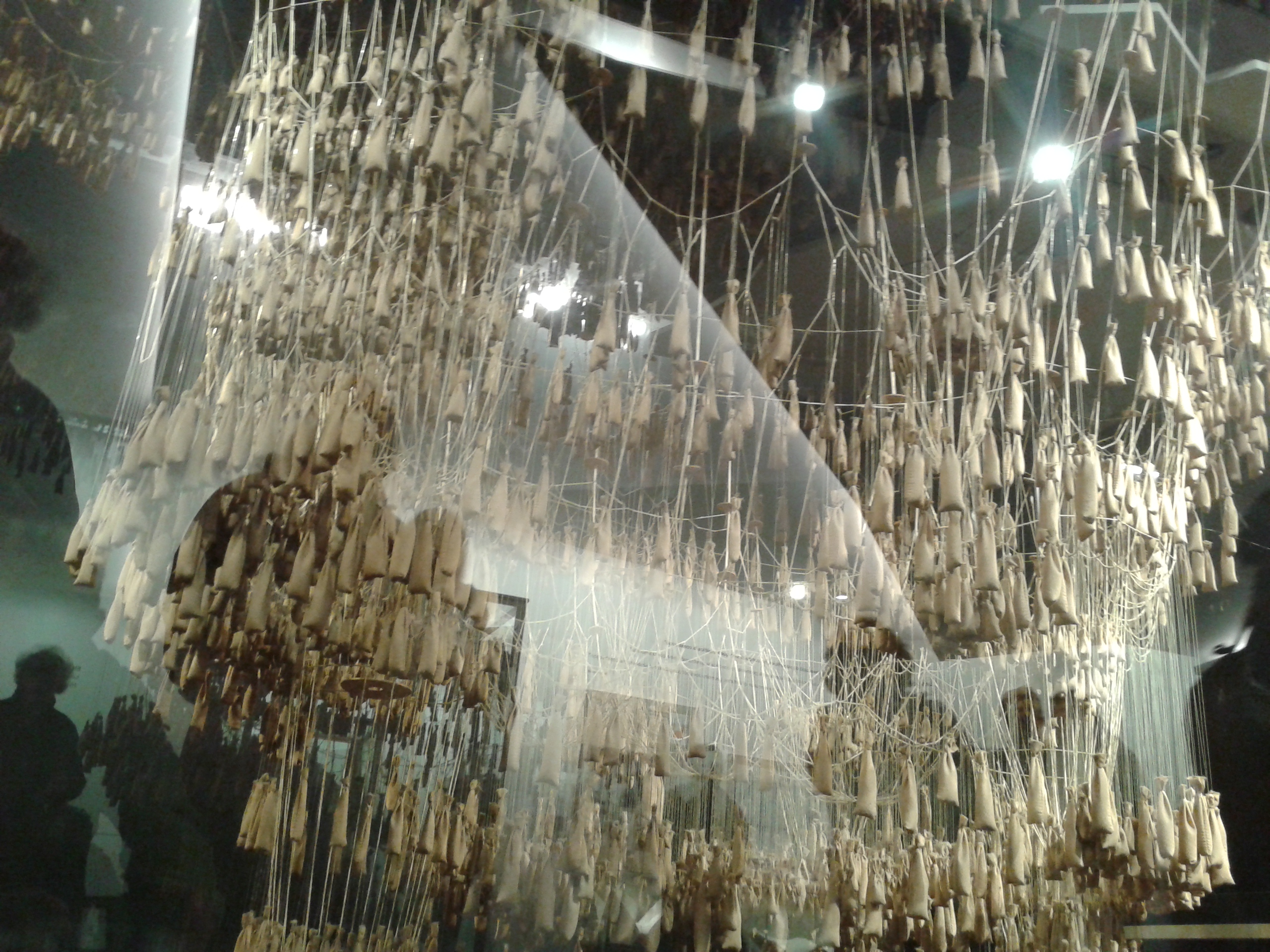
This photo is from the museum of La Sagrada Familia in Barcelona last month. All the little bags on strings are complicated enough but you can also see reflections of the onlookers in the glass case that surrounds the piece. What on earth is it?
It’s an inverted model designed by Antoni Gaudi for structural calculations. Between 1898 and 1908 Gaudi designed the Church of Colonia Guell using this innovative method. This model, which has the crypt on top and the roof at the bottom, allowed him to design the structure with all the bags of birdshot corresponding to weights of different parts of the building. Gaudi considered this project an experiment for the structural innovations, like branching inclined columns and hyperbolic paraboloid surfaces, that he would use in the Sagrada Familia.
I stood and marvelled at this model for some time, but not as long as I stood overawed by the Sagrada Familia itself. On a recent Catalonian holiday. I know – it’s alright for some – but it was only a week. When my mindful soulmate was painting, I was catching up with some writing and thinking about plotting the rest of Green Goddess. A couple of writing friends and I are meeting next week to help each other with our plots. I had to produce something for them to look at in advance, which wasn’t as complicated as Gaudi’s inverted model church.
I would like Green Goddess to be more loosely-plotted than Walls of Fire. It’s driven largely by Josie’s character. There are some important people in her life – her estranged husband Charles (and he is very estranged) her father Ken, mother-in-law Patience and friend Mags, not to mention the mysterious ‘mattock man’. And then there’s the themes that run through the story, the multiple narrative arcs, the cliff-hangers, the climax. After some early misgivings (I like that word in this context) I’m happy to report that I think this story has legs, although I’m only about 15000 words in. I’m enjoying using the first person narratives – it looks like they’ll work all the way through.
Having started with simple squares of paper, some blu-tak and a handy chimney on which to stick them, by the time I had finished I began to think I needed something like Gaudi’s model, all catenary curves and bags of birdshot, except in my darker moments the plot looked more like a pile of birdsh*t. The bits of paper ended up in the bin.
A lot of writers tell us that their characters start doing things of their own accord, and it’s happened to me as well. At the level of the plot strange things also happen – like I’ve just realised that, apparently by chance, my two main female characters will find themselves on a heroic quest at the far edge of another continent at the same time as my three main male characters are stuck at home with their pinnies on. How did that happen? I guess we’re all feminists now, thanks partly to my favourite writer Chimamanda Ngozie Adichie.
Since my last pangolin we have had World Pangolin Day, celebrating these beautiful creatures and highlighting the increasingly urgent attempts to save them. All eight species are under severe threat from, you guessed it, us. Watch the film by clicking here.
If you would like to read my next Pangolin, please sign up for it aka my newsletter – it will emerge, as mine always do, with the new moon. That’ll be 7th April.
© David Cundall