I dropped my DNA in the postbox.
Not bad for an opening line, although the explanation is less tantalising. We have joined the many thousands, if not millions, who are curious enough about their ancestry to pay for a DNA test. I’m not anticipating any surprises, the surnames in my heritage come from Yorkshire, Wales and Oxfordshire, my name appears to be a fusion of Celtic and Norse words for a valley, but you never know. At the heart of the denouement of my second novel is the protagonist’s desperate attempts to get hold of her ex-lover’s DNA. The method she eventually employs is a long long way from persuading him to spit into a tube and trust it to the Royal Mail.
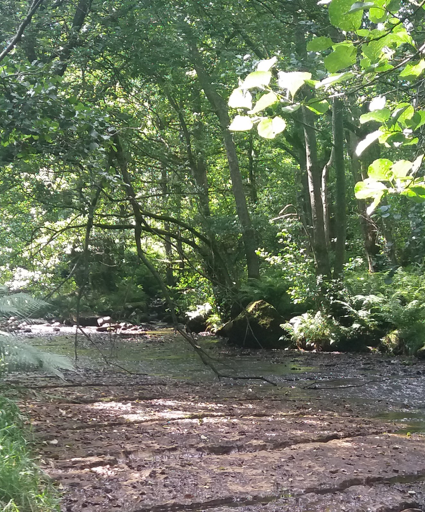
My test was a birthday present. We celebrated, the following day, with a walk in Upper Nidderdale. There was a heatwave in Yorkshire, the battery of the electric car was at its most efficient, so we got to Lofthouse with volts to spare for the return journey. We humans paced ourselves – only meandering a little way up the main valley for elevenses. Climbing through fields to Middlesmoor, we ate our picnic lunch on my parents’ memorial bench in St Chad’s churchyard. The view down the dale was one of their favourites. The steel bench, made in Scotland, should last for centuries. After remembrance, a footpath contoured us round to How Stean Beck, crossing it where the water runs over rippled limestone pavement in dappled shade.
The routine, on breaks in such walks, is that I write while my mindful soulmate paints. I usually lose focus after a few paragraphs. Restless legs decide to ease my aching back and explore. Finding a likely lump of shale lodged in a crack in the stream-bed, I retreated to the bank to dissect it. This was called “fossilising” in my youth, pottering about, picking up likely stones, bashing them if necessary. The remnant of soft shale didn’t need much help to fall apart and reveal fragments of crinoids (sea-lilies) and a tiny heart-shaped brachiopod (sea-shell). Something to show the grandchildren.
I’ve started the last (really?) edit of Novel 2 before I send it out. Another birthday present was On Writing by Stephen King which has proved very timely. I like his realistic appraisal that the best someone like me can hope for is to edge from being a competent to a good writer . His list of dont’s is short but emphatic. I’ve never been plagued by adverbs but I was guilty of trying too many variations on the word “said” so a fumed, and an announced have been replaced by said but a shrieked remains as that is what the three-year-old did. King is also adamant that you cannot write if you don’t make time to read, and I’m finally getting better at that – the to be read pile is in danger of toppling over.
Stephen King likens the process of finding a story to easing a fossil out of hiding. As someone who aspired to be a palaeontologist until I was fourteen, it’s a happy metaphor for me. Beware the hammer-wielding writer who smashes into the rock with preconceived notions of what the story is about; respect his (or her) careful colleague who takes their time to unearth the full story, with all its unexpected twists and turns, that was waiting to be found.
Imagine, for a moment, that unbroken chain of story-tellers in which we stand. Tales that were told under trees, in caves, round campfires, the pictographs, the runes, the Ogham script and so on. Is there anything left worth finding, any story still worth writing down, after so many millennia? A hallelujah chorus of countless writers across the globe say YES!
The crinoids that I found were in tiny fragments. Their natural habitat was a clear sea, some thin layers of Pennine limestone seem to be made almost entirely of crinoids. “My” tiny discs must have been washed into the mud that formed the shale after dying and disintegrating elsewhere – fossils out of their original context, but still with a story to tell. I’m not so sure about the brachiopod.
It’s only now, as I finish this bloglet off, that I realise that I share some DNA sequences with those crinoids and that brachiopod. That’s a whole lot of ancestry.
Talking of animals out of place, as we were (the sea-lilies were animals, like the corals) don’t forget the real pangolins. Until the pandemic, they were the most trafficked animals on the planet. Let’s help them restore their populations by leaving them well alone. My next offering will appear in mid-September.