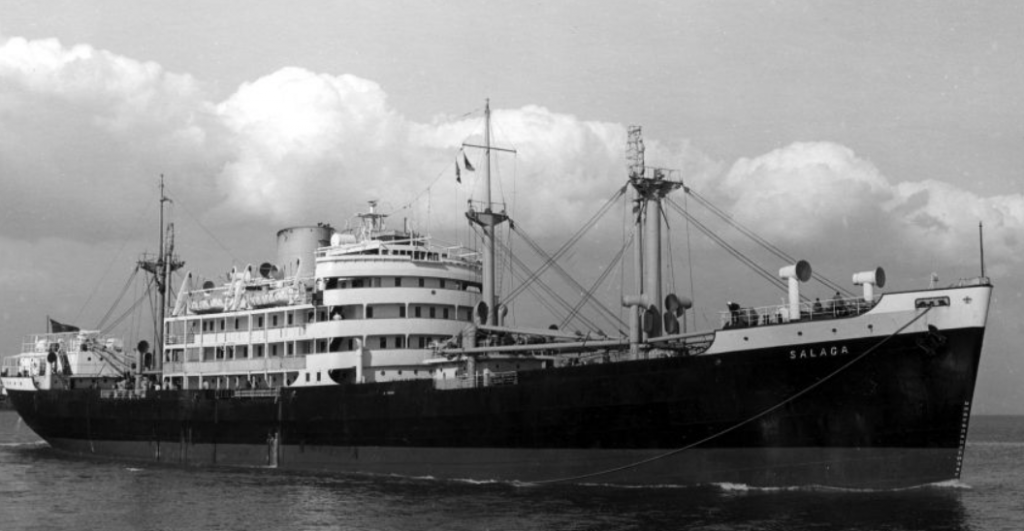
This is the MV Salaga, a cargo ship commissioned by Elder Dempster Lines to ply the route between West Africa and its home port of Liverpool. The picture was downloaded from a website devoted to Ships built on the Tyne. The same site informs me that the boat was built in 1947 by Hawthorn Leslie and Co of Hebburn, sold on to Guinea Gulf Line in 1965 and renamed Mamfe, sold on to Singapore in 1968 as the Lucky Trader and then to the Chinese Government in 1973 when it was renamed Bei Hai 5 (which translates as Northern Sea 5) until it was finally broken up in 1982.
The ship also took passengers and struggled to make it back to Liverpool on one of its regular voyages in 1959, only getting as far as Rotterdam. I know this because I was on the Salaga with my parents and siblings, returning from Nigeria after my Dad’s last tour of duty as a young missionary surgeon. But what do I remember? The smell of ocean mixed with engine oil comes from that time, I think. But do I remember stopping at Takoradi, seeing flying fish, sharks, or meeting a camel at Las Palmas de Gran Canaria? Nope. None of it – all of those things I have been told, and/or seen in photos. I was about six. Where have nearly all my memories from younger childhood gone?
That unanswered question is, I think, a sub-conscious driver for my third novel. Judging by the feedback so far from the novelists group of Leeds Writers Circle, this story has legs. I know, from my time as a paediatrician, that traumatic childhood memories can be squirrelled away out of the sight of conscious thought. My Mum reassured me that no such ordeals happened to me, though we both remember the scary Ekpo men dancing along the road near Ituk Mbang. She had a phenomenal memory until her later years – her earliest recollection was from her pram. Perhaps I am simply forgetful, but it doesn’t stop my subconscious from stoking the fires of imagination.
The name Salaga has much darker connotations for many thousands of people in West Africa, and their descendants all over the world. It’s a town in northern Ghana, the capital of East Gonja District in the Savannah region, but it was also a hub for trading slaves in the eighteenth century. Why name a ship after a slave market? Perhaps it’s just as well that it changed its name a few times before being scrapped altogether. One Hundred Wells of Salaga by Ayesha Harruna Attah, explores in fiction some of the town’s history. It’s one of the many brilliant books published by Cassava Republic Press.
In her book, Attah explores themes of identity, class and power through the lives of two women from different ends of the social spectrum. Like most good books it has layers of meaning, with the sort of texture and depth that I aspire to in my own writing. The hope for my third novel, On Thin Ground, is that the story on the surface will run in parallel to a deeper journey of discovery for Don, a man in his late seventies and failing health, who learns more about his early years.
My first novel took ten years, the second five; I’m hoping this one will take two or three. I may be speeding up as I learn the craft, but I’m also paring down – Yetunde’s House had four points of view, Not Letting Go: a beginner’s guide has two, On Thin Ground only one. This is not a progressive lack of ambition, it’s an increasing confidence to dig deeper, to trust my instincts and let my characters grow. The strip of old lining paper rolled up on the debris on my desk contains the plot so far. It doesn’t go beyond the horizon of the chapter I am now writing – risks are being taken.
I have wondered for a few weeks whether this story needed another character, and, sure enough, he has appeared fully-formed from my subconscious. Here is Don’s first encounter with him:
‘Going to make a night garden.’ A little voice to his right, as clear as day. Was his brain playing tricks again? Don turned, edged silently past the van, and went to investigate. ‘Going to like this night garden.’ The voice belonged to a small child, not much more than a toddler, standing in the gap between the second and third sheds, facing away from Don. The child wore a bright yellow waterproof playsuit and red wellies. On his back was a red bag with black spots – a ladybird backpack. The child lifted up a toy, some sort of blue doll, in his right hand and spoke to it. ‘Let’s go find.’
We live in dark times. Here in Leeds it will be the shortest day of the year in a week’s time, but we expect the weather to get colder and more miserable for a while, in tune with the consequences of the shambolic leadership of our nation. It’s so tempting to curl up and hope that it will all go away. This isn’t a great strategy for a pangolin who meets a poacher, and it’s not the best choice for those who care about good governance and honesty in public life. You may feel the good ship Probity McProbityface has sailed from our shores and won’t be back anytime soon. It’s our job to help to make the tide of history that will bring her back and find safe harbour.
I write to escape, I admit, but I also write to discover and inspire. Who knows what state we’ll be in by January, but another of these pangolins should emerge on Wednesday 13th, whatever the weather, or the politics.