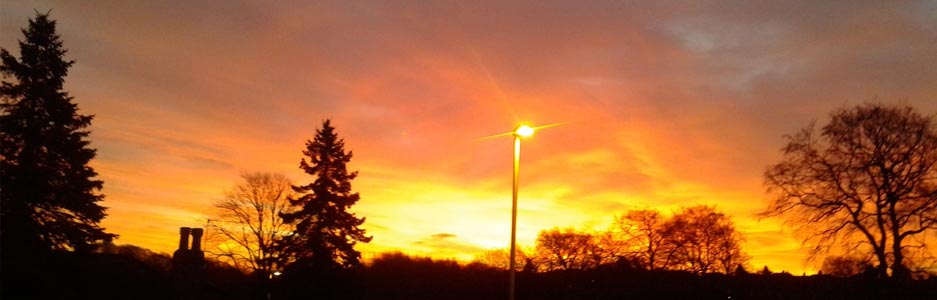
‘The Beast from the East’ was back in the UK this week with cold easterly winds and some significant snowfalls. The Ontario chapter of my followers may well chuckle when Brits complain about temperatures and wind chill that they would class as balmy for the time of year. The snowdrops are out, we know that Spring is not far away, even though it doesn’t feel like it.
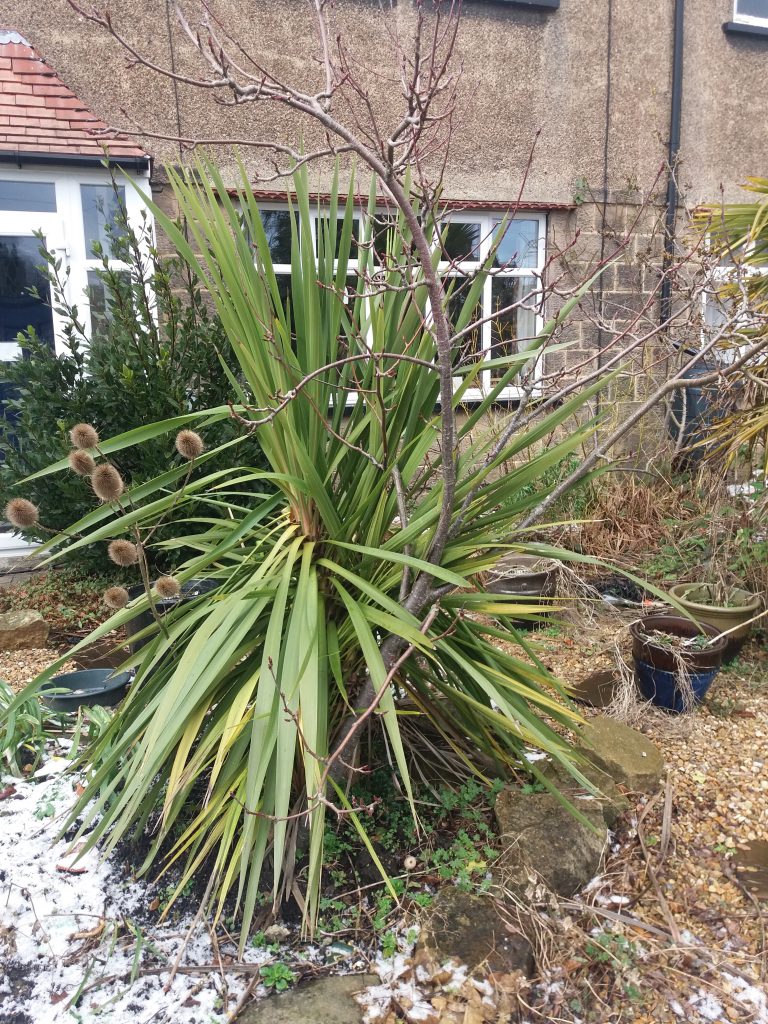
This photo was taken a few days ago. As a visual composition, it’s a mess, but it hides a good story. About a decade ago we had a really cold few weeks that killed off the tree-fern that graced our back yard. The cordyline in the front garden took longer to die, so it was at least a year, if not two, before we decided it had definitely perished. All the leaves were lifeless and blackened, the thick stems had lost their strength, any hope of a late recovery seemed lost. A friend and I spent a day getting as much of the root out as we could. Pam and I chose a pretty Sorbus with pink berries to replace the cordyline and take centre stage in that part of the garden. Cordyline shoots started to appear three years later, another four years and it dominates the patch once again. The sorbus is bowed, as if in pain, waiting for its inevitable eclipse by the vigour of its more exotic neighbour.
Some stories have to be told, however much people might think they were dead, tales that are in danger of being frozen out because they aren’t suitable for the climate. My second novel has, so far, been rejected by 100% of the agents who have been polite enough to reply. This is fine, I have much to learn. One of the agents was kind enough to give some constructive feedback. She wrote that she didn’t really get a sense of the relationship between Freya and Hereward. She might have felt differently if given the opportunity to read more of the story, but she makes a fair point about the first three chapters. Looking back over the last fourteen years of my writing journey, I can see a welcome trend – away from the general and superficial towards the particular and deep. Freya’s story, in its current form, is much more intimate than my first novel, Yetunde’s House but relatively skimpy compared to what I hope to achieve with On Thin Ground, my work-in-progress, a prequel to Freya’s story.
Does this search for deeper writing inevitably mean that my stories will become more autobiographical? I don’t think so, possibly the opposite. It’s more to do with allowing my characters to be themselves and worrying less about what readers, agents or publishers might think. This week has seen a major breakthrough in my research into Freya’s Dad’s childhood experiences. I’ve also enjoyed exchanging e-mails with Prof Cindy Connolly whose excellent book about Preventoria in the USA has provided some helpful insights into the social background of the development of these institutions in a North American context. You may be intrigued about what this has to do with On Thin Ground. There are clues in Dr Tattersall’s Dilemma, a short non-fiction piece on my website.
I’ve written before about the joys of being part of a local writers group – in my case the Leeds Writers Circle. Yesterday the novelists group debated online the potential toxicity of tulip bulbs and learnt that French wild boar will eat every last one, given half a chance. Although we may often find ourselves discussing the minutiae of menus in the ‘fifties, or the use of dialect in the right context, we do sometimes appreciate that one of us has captured something deeper – often between the lines rather than on them – the sort of earthed sensitivity to which I aspire.
Last week I read my (signed) copy of The Assault on Truth by Peter Oborne, an analysis of the pernicious and corrupting effect of political lying on both sides of the Atlantic. In his last chapter, Oborne offers some advice about what steps ordinary citizens can take to push back against the tides of deliberate misinformation. Is it a hopeless task? For the first time ever, I wrote a twitter thread summarising all his advice – resulting in not one single like or retweet. Are we so far gone as a society that we are prepared to wallow in the depths of current political dishonesty?
When the cordyline shoots broke through the soil, it was like a resurrection. We had tried really hard to get the root out, but there was still enough left for the thing to regenerate itself years later, using only the energy stored in the remnant of its root. So, whether it’s a deep compelling story that has to be told, or the probity and truth-telling that underpins compassionate society, remember the stubborn persistence of the cordyline. We look forward to see ours flowering again, the blossoms are not spectacular, but the bees love them.