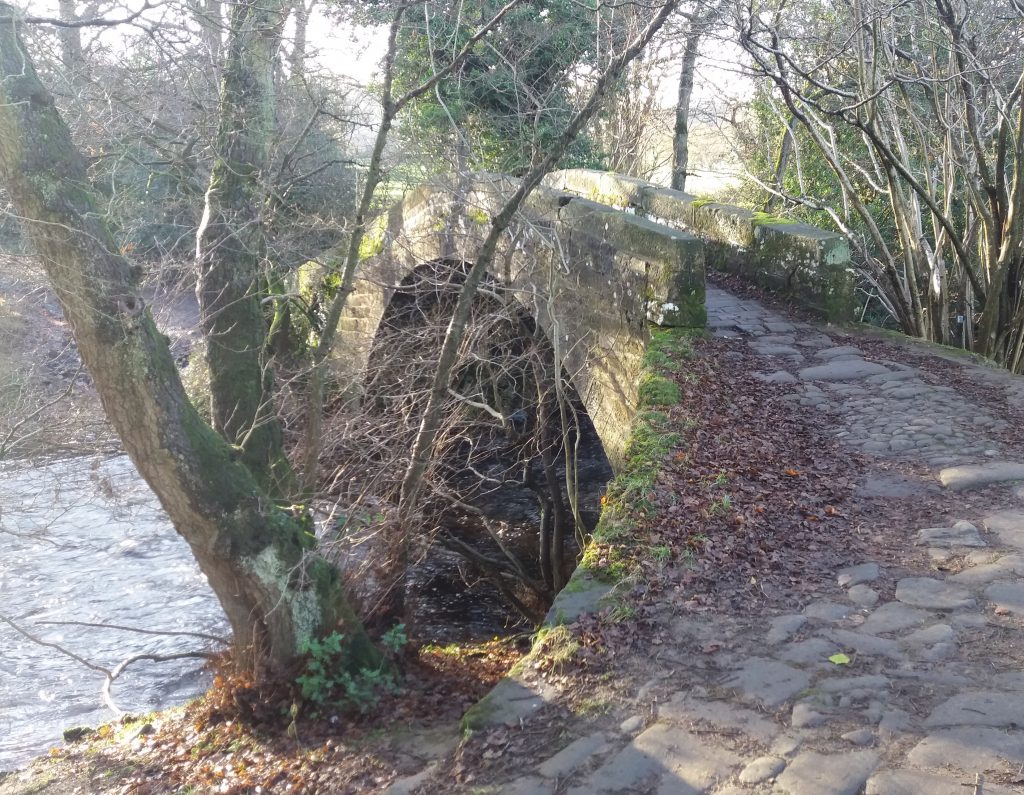
Local readers will recognise this packhorse bridge over the Washburn, a landmark which we have recently been able to revisit as the UK lockdown eases. The bridge fits into the landscape so well, it’s hard to imagine a time when it wasn’t there, or won’t be in the future. An unexpected traffic diversion forced us to start our “circular” walk in a different place than planned. This meant we would reach the bridge after lunchtime, but we were able to find a place to eat our packed lunches with a good enough view for my mindful soulmate to paint, while I scrolled.
You assumed I was scrolling through my Twitter feed, didn’t you? It’s a fair assumption – I have been known to indulge my phone, even on country walks. But no, on this occasion I had brought a length of rolled up paper which serves as my plot device. I sketched out the story arc on a scroll of scrap paper, scribbling words, arrows, circles, names, themes in a mayhem that would give any medieval scribe the heeby-jeebies. At some stage since my last Pangolin emerged, in what can best be described as a low-wattage light-bulb moment, I have realised that this story is not destined to be a full-length novel. It wants to be a novella. In the olden times, this might have been a problem, but it seems that most people these days are happy for authors to let their stories occupy the space they need to breathe.
It’s been a relief not to worry about how to stretch the story to conventional novel length, so I can concentrate on interweaving the surface plot with the more subversive one to make an immersive whole. Please note that I used neither seamless nor holistic in that aspirational statement – two words so over-used when I worked in the NHS that I am allergic to them. Chapter 9 emerged more or less unscathed from the Leeds Writers Circle Novelists Group at the weekend, the next two chapters were outlined and enscrolled on that walk, so I should be set up to write the next 6000 words or so. My hero is a quiet man in his eightieth year. Perhaps it is the level of turmoil in the world that is contributing to the literary success of quiet men like Leonard and Hungry Paul. Not that I’m trying to piggy-back on to the latest trend in books, that’s always a fool’s mission.
There’s a handy bench by the packhorse bridge which was vacant when we finally reached it, so we took the opportunity for a rest and a cuppa. The Yorkshire Post, that excellent regional newspaper, tells me that the bridge probably dates from the seventeenth century. We rarely see a packhorse or mule in these parts so this crossing point is used by walkers – the adjacent ford remains passable by four-wheel drives and tractors. A young couple walked past us and over the bridge, carrying their tot in one of those baby hiking carriers which give the child a great view and the parent a less sweaty back than more traditional methods. We passed the little family again on our way up the hill to Dob Park as they stopped to give the child a drink and to consult the map on a phone. Already our youngest child is a decade older than these parents, in another decade our two oldest grandchildren will be adults.
The UK has been mourning the passing of Prince Philip, Duke of Edinburgh. I don’t usually spend time thinking about the Royal Family, but I did read a summary of his disrupted and emotionally-scarred childhood. By all accounts, he did well to fulfil his formal roles and was a great support to his wife. At the heart of my current novella (I’m not sure that I have yet fully embraced this description), is the dawning realisation by the main character that events are forcing him to confront and understand things that happened in his earliest years. It’s not exactly an original idea for a story, there must be thousands with a similar premise, but I’m enjoying exploring his early life with him; I only have vague ideas about what he will find.
It’s not only the death of a famous almost centenarian, or the contemplation of generations crossing over to the other side (of a packhorse bridge) that has got me thinking historically. My big brother has recently had a significant birthday. He is encouraging me to follow his example and write an account of my life for the benefit of the next generation, at least one of whom has said she would find our stories interesting. Perhaps the opening sentences of mine could be: I arrived at Ituk Mbang by hospital lorry, aged six weeks, covered in the red dust of the road. Nigeria would be a British colony for another six years. The fact that I can remember very little of my early years is probably the subconscious catalyst for my work-in-progress.
I am still shocked to realise that I date from colonial times. I shouldn’t try to deny my history, personal and collective – a lesson that many in the sadly disUnited Kingdom have yet to learn. I’ve written and re-written this next sentence four times, each time straying on to some facet of my dismay at our current government. No! This is a writing bloglet so let’s finish by curling up, pangolin-like, with some comforting words from Hungry Paul on the subject of his family: Nobody keeps count, and nobody keeps score.
I look forward to sharing my next offering with you in early May. Don’t forget the real pangolins, they still need our help.