I may have mentioned in a past bloglet that I was once an orienteer. Past tense. Towards the end of our recent holiday in the Brecon Beacons we decided to go to a waterfall and plunge-pool which our daughter-in-law recommended. After a couple of miles contouring round a densely-brackened hillside on wayward sheep-tracks in hot sun, I finally realised we had parked at the wrong car park, therefore we were on a different spur. What to do? Keep going for another half-mile to reach the correct car park, find a shady painting spot for Pam, then walk back around lowland lanes to collect the car.
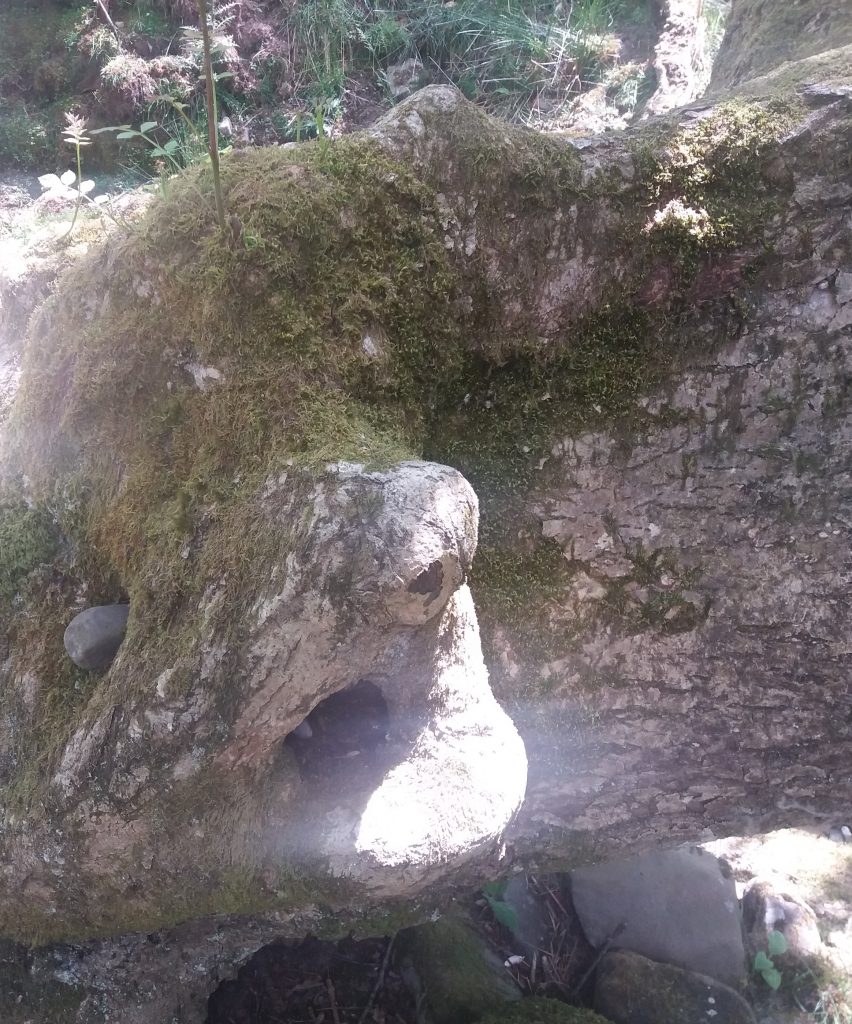
She didn’t paint the tree trunk that watched over her. Perhaps you can see what I saw when I returned to the stream side, hot and thirsty but relieved that map, terrain and wife were all coincident again. A horrified face, with a touch of Aardman’s Wallace but without the trademark teeth, one who looked like he could scarcely believe my navigational incompetence. If you look again at the tree-face, you begin to wonder whether someone has scratched off the moss so that two eyes appear – I think they probably have. It wasn’t me.
During our time away, I was chuffed to write four chapters of my work-in-progress. I took the first of these offerings to share with the Leeds Writers Circle Novelists’ group last week. The take-home message was that I needed to be more subtle in what I reveal to the reader. Whoever scratched away the moss-eyes in our tree-face didn’t need to, they should have trusted that observers would see the face without any extra clues. It’s a recurring niggle with my writing, this tendency to not trust the reader to get it, the desire to sprinkle the text with little arrows pointing readers in the right direction. I exaggerate, my signalling is a lot less obvious than plucking eyes out of moss.
We did get to the waterfall in the end, by driving up to the next ridge where a friendly farmer had opened a field as a car park, with an honesty box for a contribution of £1. It was an easy stroll to the stream, but the clouds had crept in from the West. A bolder person might have jumped straight into the pool, but any temptation I might have had to impress (she wouldn’t have been, the only time I have tried skinny-dipping I nearly broke my leg) was quickly submerged beneath a raft of logic wrapped in a damp blanket of common sense.
Is this what’s happening with my writing? Am I still too concerned about what the reader will think, am I only dipping my toes in? I’ll be happy when I can write pieces that bring the reader, apparently effortlessly, into a new world. I have recently read Sankofa by Chibundu Onuzo, Miss Benson’s Beetle by Rachel Joyce and I am just starting The Woodcock by Richard Smyth. All three make me feel that I am in the hands of invisible but very competent guides.
Change (as in cash, not everything else) is hard to come by in a pandemic – tooth fairies have had to come up with some imaginative excuses. When we returned to the car Pam put a largish note in the honesty box, twice as much as I planned to do. She would say that she is not much of an artist, but her largesse on this occasion mirrors the ethos of many in the artistic and writing communities who are so generous with their time and hard-won insights. One formative experience for me was attending a workshop with Dr Stephanie Carty. Her knowledge of human psychology, and experience as an author, have led to the publication of Inside Fictional Minds which will, I am sure, become an essential handbook for many writers. Buy it, you won’t be disappointed.
You may have noticed that this pangolin has emerged a day late, rather like its predecessor, but I’m sure you can cope. If I get my skates on, I should be able to release it just before the ref blows his whistle to start a certain football match. I hope to communicate again around August 8th.